Aller au contenu
226 923 profils classés

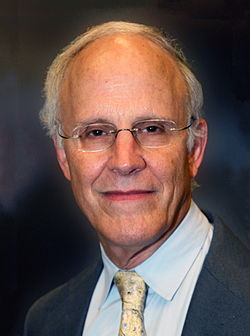
Edward Witten

États-Unis · Sur la carte · Scientifiques · Naissance en 1951 · 75 ans

Edward Witten, né le 26 août 1951 à Baltimore, est un physicien mathématicien américain, professeur de physique mathématique à l'Institute for Advanced Study de Princeton, dans le New Jersey. En 1987, il était considéré comme l'un des plus éminents physiciens vivants.

Texte issu de Wikipédia, CC BY-SA 4.0

Edward Witten : environ 806 lectures par jour, en 52 langues.

Un jour typique, sur 30 jours jusqu'au 8 novembre 2026

Le jour médian de la période comptée : une semaine d'actualité ne peut donc pas le faire bouger. La courbe en dessous montre les 406 derniers jours, un point par jour.

Une erreur ?
Comparer Revendiquer

Une vie en dates

2019Membre de l'AAASDistinction2013Membre élu de l'American Mathematical SocietyDistinction2010Médaille Isaac-NewtonDistinctionMédaille LorentzDistinction2006Prix Henri-PoincaréDistinction2005Docteur honoris causa de l'université HarvardDistinction2002Lauréats Clarivate des chercheurs les plus citésDistinction2001Clay Research AwardDistinction1999“If supersymmetry plays the role in physics that we suspect it does, then it is very likely to be discovered by the next generation of particle accelerators, either at Fermilab...”Ses propres mots30 juin 1999Foreward, written 30 juin 1999, to Supersymmetry: Unveiling the Ultimate Laws of Nature (2000) by Gordon Kane

Membre étranger de la Royal SocietyDistinction1998Médaille Oskar-KleinDistinction1996“Good wrong ideas are extremely scarce... and good wrong ideas that even remotely rival the majesty of string theory have never been seen.”Ses propres motsas quoted by John Horgan, The End of Science: Facing the Limits of Knowledge in the Twilight of the Scientific Age (1996)

1995“String theory is extremely attractive because gravity is forced upon us.”Ses propres motsas quoted by Michio Kaku, Hyperspace: A Scientific Odyssey Through Parallel Universes, Time Warps, and the 10th Dimension (1995)

1993Médaille James-MadisonDistinction1992“Most people who haven't been trained in physics probably think of what physicists do as a question of incredibly complicated calculations, but that's not really the essence of it.”Ses propres mots"Edward Witten" interview, Superstrings: A Theory of Everything? (1992) ed. P.C.W. Davies, Julian Brown

“String theory at its finest is, or should be, a new branch of geometry.”Ses propres mots"Edward Witten" interview, Superstrings: A Theory of Everything? (1992) ed. P.C.W. Davies, Julian Brown

“It's been said that string theory is part of the physics of the twenty-first century that fell by chance into the twentieth century.”Ses propres mots"Edward Witten" interview, Superstrings: A Theory of Everything? (1992) ed. P.C.W. Davies, Julian Brown

1990Médaille FieldsDistinction1985Prix Dirac de l'ICTPDistinction1982Prix MacArthurDistinction1951Naissance26 août 1951

Autour d’Edward

Médias et musique

Photos 3

Citations 4

,
Edward Witten
,
4 déclarations, les plus récentes d'abord
  1. It was clear that if I didn't spend the rest of my life concentrating on string theory, I would simply be missing my life's calling.

    1996 · as quoted by John Horgan, The End of Science: Facing the Limits of Knowledge in the Twilight of the Scientific Age (1996), Ses propres mots

  2. Generally speaking, all the really great ideas of physics are really spin-offs of string theory...

    1996 · as quoted by John Horgan, The End of Science: Facing the Limits of Knowledge in the Twilight of the Scientific Age (1996), Ses propres mots

  3. Quantum mechanics... developed through some rather messy, complicated processes stimulated by experiment.

    1992 · "Edward Witten" interview, Superstrings: A Theory of Everything? (1992) ed. P.C.W. Davies, Julian Brown, Ses propres mots

Wikiquote, CC BY-SA 4.0

Distinctions

Membre de l'AAAS2019
Prix mondial des sciences Albert-Einstein2016
Membre élu de l'American Mathematical Society2013
Prix de physique fondamentale2012
Médaille Isaac-Newton2010
Médaille Lorentz2010
Prix Crafoord en mathématiques2008
Prix Henri-Poincaré2006
Prix Harvey2005
Docteur honoris causa de l'université Harvard2005
National Medal of Science2002
Lauréats Clarivate des chercheurs les plus cités2002
Clay Research Award2001
Prix Nemmers en mathématiques2000
Membre étranger de la Royal Society1999
Médaille Oskar-Klein1998
Conférence Gibbs1998
Prix Dannie-Heineman de physique mathématique1998
Médaille James-Madison1993
Médaille Fields1990
Prix Alan T. Waterman1986
Médaille Albert-Einstein1985
Prix Dirac de l'ICTP1985
Prix MacArthur1982
Membre de la Société américaine de physique
Membre de l'Académie américaine des arts et des sciences
Prix Crafoord

À propos de cette personne

Il effectue des recherches sur la théorie des supercordes. Il en est considéré comme l'un de ses plus importants participants, notamment grâce à l'élaboration de la théorie M, première théorie des cordes ouvrant un horizon mathématique non perturbatif.

Texte issu de Wikipédia, CC BY-SA 4.0

Pays
États-Unis
Catégorie
Scientifiques
Type
Scientifique
Statut
En vie
Dates
Naissance en 1951 · 75 ans

Sur le web