Aller au contenu
226 923 profils classés

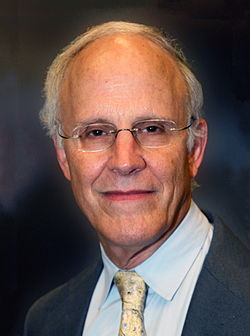
David J. Gross

États-Unis · Sur la carte · Scientifiques · Naissance en 1941 · 85 ans

David Jonathan Gross, né le 19 février 1941 à Washington, est un physicien américain travaillant, en 2010, principalement en théorie des cordes.

Texte issu de Wikipédia, CC BY-SA 4.0

David J. Gross : environ 278 lectures par jour, en 73 langues.

Un jour typique, sur 30 jours jusqu'au 8 novembre 2026

Le jour médian de la période comptée : une semaine d'actualité ne peut donc pas le faire bouger. La courbe en dessous montre les 406 derniers jours, un point par jour.

Une erreur ?
Comparer Revendiquer

Une vie en dates

2015“Physics is always a gamble; it is a game of exploration. That’s the fun of it. We never know for sure what will happen.”Ses propres mots"Physics is always a gamble", an interview with David Gross by Shubashree Desikan, The Hindu (2015)

2013“Remarkably, the building of the Standard Model - the theory of how particles and forces interact - was the success of the conservatives.”Ses propres mots"Waiting for the Revolution", an interview of David Gross by Peter Byrne, Quanta Magazine (2013)

2004“... From the age of 13, I was attracted to physics and mathematics. My interest in these subjects derived mostly from popular science books that I read avidly.”Ses propres mots"David J. Gross - Biographical", Nobel Prize in Physics, nobelprize.org (2004)

“The universe has been expanding since the big bang, thus early on it was hot and dense.”Ses propres mots"The Discovery of Asymptotic Freedom and the Emergence of QCD", Nobel Lecture, p. 79, nobelprize.org (2004)

Grande médaille de l'Académie des sciencesDistinctionPrix Nobel de physiqueDistinction2003High Energy and Particle Physics PrizeDistinction2000Médaille Oskar-KleinDistinctionPrix HarveyDistinction1988Prix Dirac de l'ICTPDistinction1987Prix MacArthurDistinction1986Prix SakuraiDistinction1941Naissance19 février 1941

Autour de David

Médias et musique

Photos 1

Citations 3

,
David J. Gross
,
3 déclarations, les plus récentes d'abord
  1. Traditionally, fundamental theories of nature have had a tendency to break down at short distances.

    "Chapter 7. Asymptotic Freedom, Confinement and QCD" in History of original ideas and basic discoveries in particle physics, edited by, Ses propres mots

  2. Why is space-time doomed? There are many reasons, among which: In string theory we can change the dimension of space-time by changing the strength of the string force.

    "Einstein and the Search for Unification", p. 11, in The legacy of Albert Einstein: a collection of essays in celebration of the year of, Ses propres mots

  3. We now know that string theory and quantum field theory can often be different ways of looking at exactly the same phenomena.

    (quote at 1:53:25 of 2:13:05 in video), Ses propres mots

Wikiquote, CC BY-SA 4.0

Distinctions

Prix Nobel de physique2004
Grande médaille de l'Académie des sciences2004
High Energy and Particle Physics Prize2003
Prix Harvey2000
Médaille Oskar-Klein2000
Prix Dirac de l'ICTP1988
Prix MacArthur1987
Prix Sakurai1986
Docteur honoris causa de l'université hébraïque de Jérusalem
Membre de la Société américaine de physique

À propos de cette personne

Il a partagé en 2004 le prix Nobel de physique avec ses deux anciens étudiants Frank Wilczek et David Politzer pour leur découverte commune de la liberté asymptotique dans la chromodynamique quantique, théorie qu'ils ont également introduite. Il est également coinventeur de la théorie des cordes hétérotique en compagnie de Jeffrey Harvey, Emil Martinec et Ryan Rohm.

Texte issu de Wikipédia, CC BY-SA 4.0

Pays
États-Unis
Catégorie
Scientifiques
Type
Scientifique
Statut
En vie
Dates
Naissance en 1941 · 85 ans

Sur le web