Wolfgang Pauli
États-Unis · Sur la carte · Scientifiques · 1900 - 1958 · 58 ans
Wolfgang Ernst Pauli (25 avril 1900 à Vienne - 15 décembre 1958 à Zurich) est un physicien autrichien connu pour sa définition du principe d'exclusion en mécanique quantique, ou principe de Pauli, qui lui valut le prix Nobel de physique de 1945. Il est également lauréat de la médaille Franklin en 1952.
Texte issu de Wikipédia, CC BY-SA 4.0
Wolfgang Pauli : environ 723 lectures par jour, en 93 langues.
Un jour typique, sur 30 jours jusqu'au 14 novembre 2026
Le jour médian de la période comptée : une semaine d'actualité ne peut donc pas le faire bouger. La courbe en dessous montre les 400 derniers jours, un point par jour.
Une erreur ?Une vie en dates
Autour de Wolfgang


Parents
Conjoints

Est-ce toute la famille ?
Seuls les proches qui ont un profil ici sont représentés : une famille peut donc être plus grande. Un lien peut aussi être erroné. Un mariage n'apparaît comme terminé que si sa fin est enregistrée : un mariage montré ici peut donc avoir pris fin.
Corriger cette familleMédias et musique
Photos 5
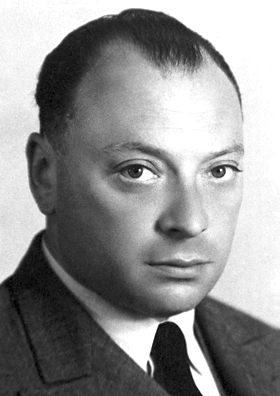

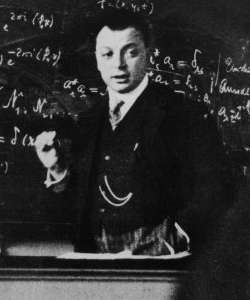

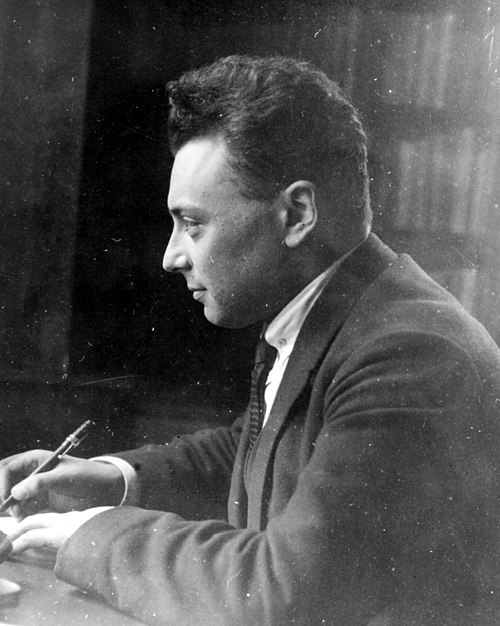
Citations 4
This is to show the world that I can paint like Titian. [A big drawing of a rectangle] Only technical details are missing.
The fact of the existence of two theories [causal and acausal] that contradict each other in Jung … corresponds psychologically to the vascillation between 3 and 4.
I have done a terrible thing, I have postulated a particle that cannot be detected.
Distinctions
À propos de cette personne
À partir de 1929, il travaille avec Werner Heisenberg à l'élaboration de la théorie quantique des champs, ouvrant la construction de modèles de description des particules élémentaires qui combinent les règles de la mécanique quantique avec celles de la relativité restreinte, y compris pour le modèle standard. Pauli est aussi connu pour l'invention - soit la postulation théorique - , en 1930, du neutrino, particule élémentaire surprenante et paradoxale puisqu'elle ne possède en principe ni charge ni masse, et qu'elle n'interagit que très faiblement avec la matière. Avec entre autres Einstein, Bohr, Heisenberg et Schrödinger, il fait partie de ceux qui ont pensé la révolution relativiste et quantique de la physique moderne, et l'ébranlement philosophique sans précédent qu'elle provoque.
Texte issu de Wikipédia, CC BY-SA 4.0