Aller au contenu
226 923 profils classés

William Laud

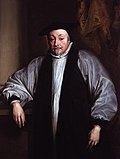
William Laud (Reading le 7 octobre 1573 - Londres le 10 janvier 1645) est un ecclésiastique anglais, nommé archevêque de Cantorbéry à partir de 1633 pendant le règne de Charles Ier. Arrêté en 1640, il est exécuté en 1645. En matière de politique d'église, Laud est autocratique.

Texte issu de Wikipédia, CC BY-SA 4.0

William Laud : environ 167 lectures par jour, en 32 langues.

Un jour typique, sur 30 jours jusqu'au 9 novembre 2026

Le jour médian de la période comptée : une semaine d'actualité ne peut donc pas le faire bouger. La courbe en dessous montre les 111 derniers jours, un point par jour.

Une erreur ?
Comparer

Une vie en dates

1645Décès10 janvier 16451639“I have been informed that some masters come to St. Mary's, and stand or sit there bare in sermon time, not out of any devotion, but only to hide their hats...”Ses propres mots4 octobre 1639Letter to the vice-chancellor of Oxford University (4 octobre 1639), quoted in The Works of the Most Reverend Father in God, William Laud,

“No man can set a better state of the question between Scripture and tradition, than Hooker doth.”Ses propres motsA Relation of the Conference betweene William Lawd...and Mr. Fisher the Jesuite (1639), quoted in The Works of the Most Reverend Father in

1638“Mr. Alex. Henderson, who went all this while for a quiet and well-spirited man, hath showed himself a most violent and passionate man, and a Moderator without moderation.”Ses propres mots3 décembre 1638Letter to the Marquis of Hamilton (3 décembre 1638), quoted in The Works of the Most Reverend Father in God, William Laud, sometime Lord

1637“It is versus altare, 'towards His altar', as the greatest place of God's residence upon earth.”Ses propres mots16 juin 1637Speech in the Star Chamber at the censure of John Bastwick, Henry Burton and William Prynne (16 juin 1637), quoted in The Works of the Most

1633“I had a serious offer made me again to be a Cardinal. ... But my answer again was, that something dwelt within me which would not suffer that, till Rome were other than it is.”Ses propres mots17 août 1633Diary (17 août 1633), quoted in The Works of the Most Reverend Father in God, William Laud, sometime Lord Archbishop of Canterbury.

1625“The King is God's immediate lieutenant upon earth; and therefore one and the same action is God's by ordinance, and the King's by execution.”Ses propres mots19 juin 1625Sermon preached at Whitehall (19 juin 1625), quoted in The Works of the Most Reverend Father in God, William Laud, sometime Lord Archbishop

1573Naissance7 octobre 1573

Médias et musique

Photos 8

Citations 4
,
William Laud
,
4 déclarations, les plus récentes d'abord
  1. Wednesday, Coronation-day, King Charles took his journey northward, against the Scottish covenanting rebels. God of His infinite mercy bless him with health and success.

    27 mars 1639 · Diary (27 mars 1639), quoted in The Works of the Most Reverend Father in God, William Laud, sometime Lord Archbishop of Canterbury. Volume, Ses propres mots

  2. The tumults in Scotland, about the Service-Book offered to be brought in, began Julii 23, 1637, and continued increasing by fits, and hath now brought that kingdom in danger.

    29 avril 1638 · Diary (29 avril 1638), quoted in The Works of the Most Reverend Father in God, William Laud, sometime Lord Archbishop of Canterbury. Volume, Ses propres mots

  3. I know the Jesuits are very cunning at these tricks; but if you have no more hold of your printers, than that the press must lie thus open to their corruption.

    15 septembre 1637 · Letter to William Chillingworth (15 septembre 1637), quoted in The Works of the Most Reverend Father in God, William Laud, sometime Lord, Ses propres mots

Wikiquote, CC BY-SA 4.0

À propos de cette personne

Le laudianisme fait référence à un ensemble de règles sur les questions rituelles, en particulier, qui ont été appliquées par Laud afin de maintenir un culte uniforme en Angleterre et au pays de Galles, conformément aux préférences du roi. Elles sont précurseures des vues de la Haute Église. En théologie, Laud est accusé d'être un arminien et un opposant au calvinisme, ainsi que de favoriser secrètement les doctrines catholiques romaines (voir Arminianisme dans l'Église d'Angleterre). Sur ces trois terrains, les clercs et les laïques puritains le considèrent comme un adversaire redoutable et dangereux. Laud favorise les érudits et est un important collectionneur de manuscrits. Il poursuit des contacts œcuméniques avec l'Église orthodoxe grecque. Le jeu de mots : « donnez de grands éloges au Seigneur et le petit Laud au diable » est un avertissement au roi Charles attribué à Archibald Armstrong, le bouffon officiel de la cour. Laud en effet était connu pour être susceptible sur la question de sa petite taille.

Texte issu de Wikipédia, CC BY-SA 4.0

Pays
Royaume-Uni
Catégorie
Universitaires
Type
Universitaire
Statut
Décédé(e)
Dates
1573 - 1645 · 71 ans