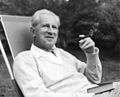
Friedrich Max Müller
Allemagne · Sur la carte · Universitaires · 1823 - 1900 · 76 ans
Friedrich Max Müller, plus connu sous le nom de Max Müller, né le 6 décembre 1823 à Dessau et mort le 28 octobre 1900 à Oxford, est un philologue et orientaliste allemand.
Texte issu de Wikipédia, CC BY-SA 4.0
Friedrich Max Müller : environ 307 lectures par jour, en 51 langues.
Un jour typique, sur 30 jours jusqu'au 6 novembre 2026
Le jour médian de la période comptée : une semaine d'actualité ne peut donc pas le faire bouger. La courbe en dessous montre les 400 derniers jours, un point par jour.
Une erreur ?Une vie en dates
Autour de Friedrich

 Friedrich Wilhelm Joseph Schelling A enseigné à Friedrich
 Friedrich Rückert A enseigné à Friedrich
 Hermann Lotze A enseigné à Friedrich
 Eugène Burnouf A enseigné à Friedrich
 Georg Bühler A eu pour maître Friedrich
 Johann Gottfried Jakob Hermann A enseigné à Friedrich
- Christian Hermann Weisse A enseigné à Friedrich
 Moriz Haupt A enseigné à Friedrich
- Reinhold Klotz A enseigné à Friedrich
Parents

 Friedrich Max Müller
Conjoints
Enfants

Est-ce toute la famille ?
Seuls les proches qui ont un profil ici sont représentés : une famille peut donc être plus grande. Un lien peut aussi être erroné. Un mariage n'apparaît comme terminé que si sa fin est enregistrée : un mariage montré ici peut donc avoir pris fin.
Corriger cette familleMédias et musique
Photos 2


Citations 4
, We all come from the East - all that we value most has come to us from the East, and in going to the East...
It is almost impossible to speak of religion at all, without giving offence either on the right or on the left.
India is much riper for Christianity than Rome or Greece was at the time of St. Paul.
Distinctions
À propos de cette personne
L’un des fondateurs des études indiennes et de la mythologie comparée, bien que ses propres interprétations (également appelées mythologie solaire) aient fait l’objet de critiques, on lui doit d’avoir introduit un nouveau domaine d’études comparées en histoire des religions. Il a dirigé l’édition des Livres sacrés de l'Orient, une série de 50 volumes de traductions en anglais qui s’est poursuivie après sa mort.
Texte issu de Wikipédia, CC BY-SA 4.0