Aller au contenu
228 584 profils classés

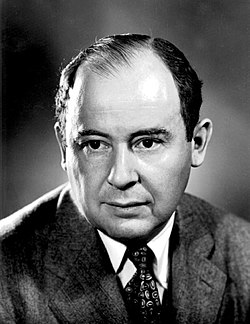
John von Neumann

Hongrie · Sur la carte · Universitaires · 1903 - 1957 · 53 ans · aussi États-Unis

John von Neumann (Neumann János Lajos) (ˈnojmɒn ˈjaːnoʃ ˈlɒjoʃ, János Lajos Neumann en hongrois), né le 28 décembre 1903 à Budapest et mort le 8 février 1957 à Washington, est un polymathe, logicien, mathématicien et physicien américano-hongrois.

Texte issu de Wikipédia, CC BY-SA 4.0

John von Neumann : environ 3 435 lectures par jour, en 102 langues.

Un jour typique, sur 30 jours jusqu'au 11 novembre 2026

Le jour médian de la période comptée : une semaine d'actualité ne peut donc pas le faire bouger. La courbe en dessous montre les 400 derniers jours, un point par jour.

Une erreur ?
Comparer

Une vie en dates

1999Personnalité de l'année selon Financial TimesDistinction1957Décès8 février 19571956Médaille Carl-Gustaf-RossbyDistinctionMédaille de la LibertéDistinctionPrix Albert-EinsteinDistinctionPrix Enrico-FermiDistinction1955“The sciences do not try to explain, they hardly even try to interpret, they mainly make models.”Ses propres mots"Method in the Physical Sciences", in The Unity of Knowledge (1955), ed. L. G. Leary (Doubleday & Co., New York), p. 157

1953“The total subject of mathematics is clearly too broad for any one of us.”Ses propres mots10 avril 1953Letter to H. D. Kloosterman (10 avril 1953), unpublished, John von Neumann Archive, Library of Congress, Washington, D.C., as quoted by

1950“For progress there is no cure.... The only safety possible is relative, and it lies in an intelligent exercise of day-to-day judgement.”Ses propres mots"Can we survive Technology?" 1950.

1947“I think that it is a relatively good approximation to truth - which is much too complicated to allow anything but approximations - that mathematical ideas originate in empirics.”Ses propres mots"The Mathematician", in The Works of the Mind (1947) edited by R. B. Heywood, University of Chicago Press, Chicago

Conférence GibbsDistinctionMédaille présidentielle du MériteDistinctionMembre associé de la Société d'économétrieDistinction1945Membre honoraire de l'Institut de statistique mathématiqueDistinction1938Prix BôcherDistinction1903“When we talk mathematics, we may be discussing a secondary language built on the primary language of the nervous system.”Ses propres motsAs quoted in John von Neumann, 1903-1957 (1958) by John C. Oxtoby and B. J. Pettis, p. 128

“It is just as foolish to complain that people are selfish and treacherous as it is to complain that the magnetic field does not increase unless the electric field has a curl.”Ses propres motsAs quoted "John von Neumann (1903 - 1957)" by Eugene Wigner, in Year book of the American Philosophical Society (1958); later in Symmetries

Naissance28 décembre 1903

Autour de John

Médias et musique

Photos 8

Citations 4

,
John von Neumann
,
4 déclarations, les plus récentes d'abord
  1. Any one who considers arithmetical methods of producing random digits is, of course, in a state of sin.

    On mistaking pseudorandom number generators for being truly "random" - this quote is often erroneously interpreted to mean that von Neumann, Ses propres mots

  2. You should call it entropy, for two reasons. In the first place your uncertainty function has been used in statistical mechanics under that name, so it already has a name.

    Suggesting to Claude Shannon a name for his new uncertainty function, as quoted in Scientific American Vol. 225 No. 3, (1971), p. 180., Ses propres mots

  3. Young man, in mathematics you don't understand things. You just get used to them.

    Reply, according to Dr. Felix T. Smith of Stanford Research Institute, to a physicist friend who had said "I'm afraid I don't understand, Ses propres mots

Wikiquote, CC BY-SA 4.0

Distinctions

Personnalité de l'année selon Financial Times1999
Médaille de la Liberté1956
Médaille Carl-Gustaf-Rossby1956
Prix Enrico-Fermi1956
Prix Albert-Einstein1956
Conférence Gibbs1947
Médaille présidentielle du Mérite1947
Membre associé de la Société d'économétrie1947
Membre honoraire de l'Institut de statistique mathématique1945
Prix Bôcher1938

À propos de cette personne

Il a apporté d'importantes contributions en mécanique quantique, en analyse fonctionnelle, en logique mathématique, en logique quantique, en informatique théorique, en sciences économiques et dans beaucoup d'autres domaines des mathématiques, de la physique et de l'économie comportementale. Il a participé à plusieurs programmes de recherche militaire américains, dont le projet Manhattan, ayant abouti à la création de la bombe atomique.

Texte issu de Wikipédia, CC BY-SA 4.0

Pays
Hongrie
Catégorie
Universitaires
Type
Universitaire
Statut
Décédé(e)
Dates
1903 - 1957 · 53 ans

Sur le web