Gabriel Fauré
France · Sur la carte · Musiciens · 1845 - 1924 · 79 ans
Gabriel Fauré, né le 12 mai 1845 à Pamiers dans l'Ariège et mort le 4 novembre 1924 à Paris, est un compositeur, organiste, pianiste et pédagogue musical français. Élève de Saint-Saëns et de Gustave Lefèvre à l'École Niedermeyer, il est d'abord maître de chapelle de l'église de la Madeleine à Paris.
Texte issu de Wikipédia, CC BY-SA 4.0
Gabriel Fauré : environ 799 lectures par jour, en 61 langues.
Un jour typique, sur 30 jours jusqu'au 8 novembre 2026
Le jour médian de la période comptée : une semaine d'actualité ne peut donc pas le faire bouger. La courbe en dessous montre les 402 derniers jours, un point par jour.
Une erreur ?Une vie en dates
Autour de Gabriel

 Maurice Ravel A eu pour maître Gabriel
 Camille Saint-Saëns A enseigné à Gabriel, a influencé Gabriel
 Nadia Boulanger A eu pour maître Gabriel
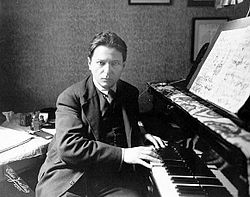 George Enesco A eu pour maître Gabriel
 Lili Boulanger A eu pour maître Gabriel
 Alfredo Casella A eu pour maître Gabriel
 Émile Jaques-Dalcroze A eu pour maître Gabriel
 Charles Koechlin A eu pour maître Gabriel
 Mélanie Bonis A eu pour maître Gabriel
 André Messager A eu pour maître Gabriel
 Louis Aubert A eu pour maître Gabriel
 Jean Roger-Ducasse A eu pour maître Gabriel
 Paul Ladmirault A eu pour maître Gabriel
 Raoul Laparra A eu pour maître Gabriel
 Henry Février A eu pour maître Gabriel
- Émile Vuillermoz A eu pour maître Gabriel
 Armande de Polignac A eu pour maître Gabriel
 Charles Panzéra A eu pour maître Gabriel
 Gustave Lefèvre A enseigné à Gabriel
 Joséphine Boulay A eu pour maître Gabriel
 Gabriel Fauré
Conjoints
Enfants
Est-ce toute la famille ?
Seuls les proches qui ont un profil ici sont représentés : une famille peut donc être plus grande. Un lien peut aussi être erroné.
Corriger cette familleAlbums 24
 FOFauré: Requiem / Ravel Ma Mere L'Oye
 RORomantic French Music for Guitar and Orchestra
Médias et musique
Écouter
SpotifyPhotos 8


Citations 5
, To know an art really well, one must know everything about it, both its origins and its development.
How many times have I asked myself what use music is? And what am I translating? What feelings? What ideas? How can I express something I do not understand myself?
He denied the presence of inspiration: "Without work, which is art, there is nothing," he said.
Distinctions
À propos de cette personne
Il en assure plus tard les fonctions d'organiste, titulaire du grand orgue. Il est ensuite nommé professeur de composition au Conservatoire de Paris, puis directeur de l’établissement de 1905 à 1920. Il est l'un des plus grands compositeurs français de la fin du XIXe et du début du XXe siècles.
Texte issu de Wikipédia, CC BY-SA 4.0


